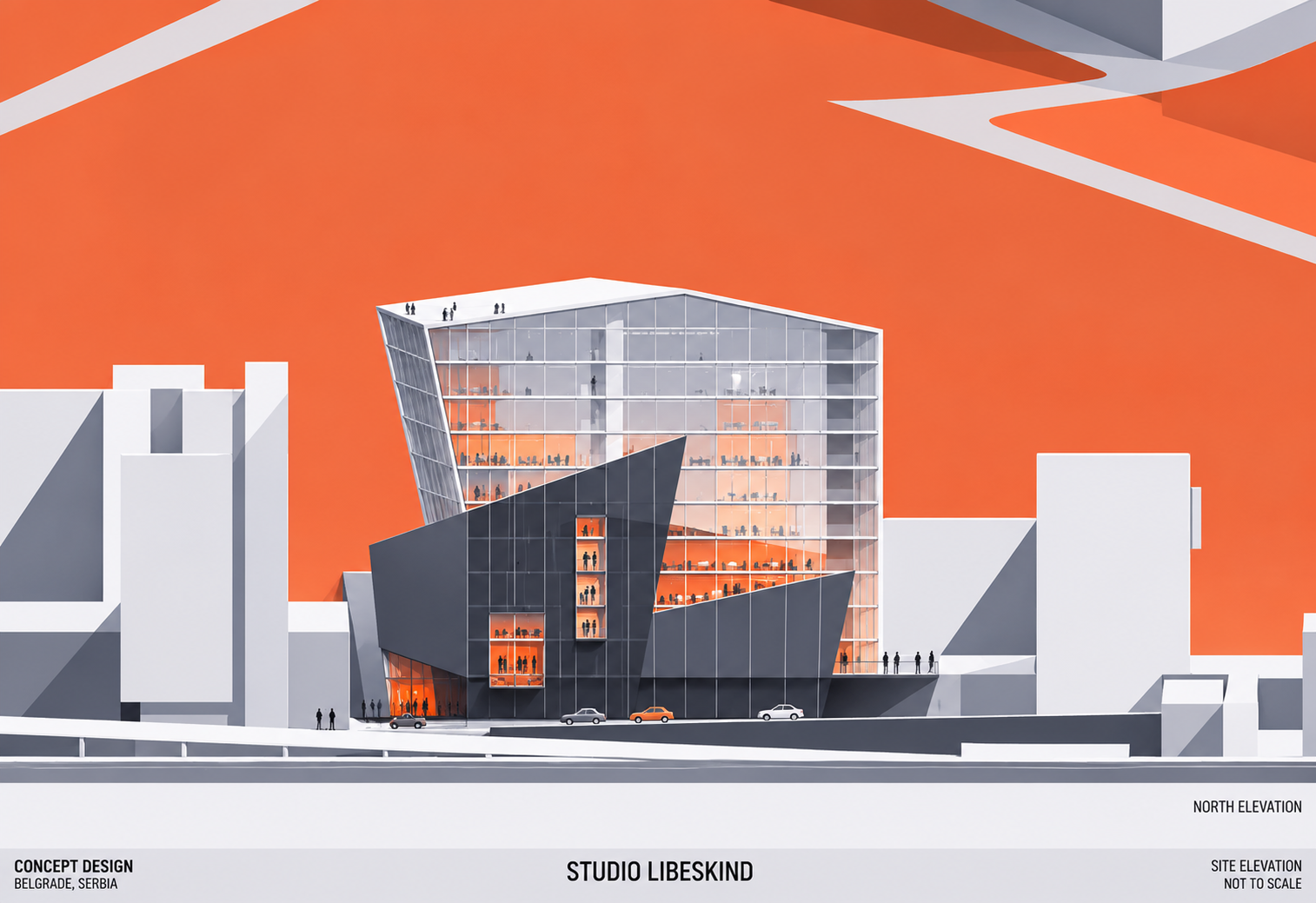
Serbia’s former state printing works
In 2018, the former Serbian state printing house was a diamond in the rough in up-and-coming Belgrade. In collaboration with Studio Libeskind, SORAVIA and CMb.industries, lobbying and development work was carried out to give this urban mine a new lease of life.
Serbia is home to 7.1 million people. A figure that corresponds to around 1.4% of the population of the EU or 0.0007% of the world’s population. Around 1,647,490 of these live in the metropolitan area of the capital Belgrade. Serbia, a region of great cultural and historical importance and scenic beauty, covers an area of 88,361 km², which is approximately 0.05% of the earth’s surface. The “white city” accounts for 359.96 km² and the so-called BIGZ building, which once housed the state printing office of the former Yugoslavia, for 43,465 m².
Like a giant newspaper printing press, this jewel of a building, built in 1938 in the spirit of functionalism, rises eleven storeys into the Belgrade sky and bores two storeys deep into the urban ground. Although the building has also been influenced by other disciplines since 1940, “black art” has left its mark on the building complex: the printer’s bale for inking the printing block has become the logo and landmark of the BIGZ.
Intermediate space and intermediate time – The BIGZ as a missing link
Situated in the heart of the city, on a busy boulevard, in the immediate vicinity of the city highway, just one kilometer from the main train station and only twelve kilometers from Nikola Tesla Airport, the BIGZ is located between two bridges that connect the old and new Belgrade. Built between the two world wars in a city that lies between central and south-eastern Europe and the Middle East, the BIGZ embodies a symbol of Belgrade’s striking dualities, not only geographically but also in its appearance.
“Belgrade is the ugliest city in the world in the most beautiful place in the world”, Le Corbusier once wrote about the current capital of Serbia, whose ancient name was Belgrade.
On various levels, the BIGZ thus holds great potential for linking Belgrade’s past, present and future.
Upswing through change – The BIGZ as a building
“Just as you are, so are your buildings.”
Louis Henri Sullivan
For Louis Henri Sullivan, who is today regarded as one of the first great high-rise architects and a pioneer of the form-follows-function movement, man and architecture were inextricably linked. A guiding principle that is not only important for the BIGZ building for reasons of architectural history, but also for the reorientation of this famous Belgrade landmark. Designed and built by Dragiša Brašovan, a leading Serbian representative of modern architecture, the BIGZ is today considered a classic example of the functionalist style.
While the building was the first reinforced concrete skeleton structure in Belgrade to be preserved as a listed building, this is not possible for the spirit of renewal. The former innovative power of this architectural manifestation of Serbian belief in progress can only be revived by repositioning its content and thus regaining its former legitimacy. If one limits the meaning of the term functionalism not only to architecture, but also takes into account the philosophical approaches of this movement, clear content-related premises for the revitalization concept of the building emerge: The functionalist school of thought never considers issues in isolation, but is always concerned with their diverse interrelationships and references to the environment.
Transition not downfall – The BIGZ as the cradle of protomodernism
The foundation for a successful redesign of the BIGZ is therefore not the creation of a monoculture, such as in the form of the building’s former use as the headquarters of the former Yugoslavian State Printing Office, but rather a cross-disciplinary orientation. After all, interdisciplinary use is not only a guarantee for risk minimization, but is already enshrined in the architecture itself, which, with its open, spacious and easily adaptable halls, opens up a wealth of scope for action in order to be able to react flexibly to new social requirements and be able to cope with the changing times. The given spatial structure finds an ideal counterpart in the inhomogeneity of the cultural and creative industries, which currently comprises a total of eleven different sub-markets and can therefore play an important role in the new use of the building.
Freedom through space – the BIGZ as an enabling space
In line with Beograd’s genetic bridging function, the cultural and creative industries span the arc to a world that is still experiencing fundamental upheavals and yet is slowly beginning to awaken from its state of shock. New concepts are called for, promoted and tested. All milieus, areas and sectors seem to be affected – including the construction and real estate industries. However, innovative strength requires urban enabling spaces, incubators for the latest trends, nuclei for ideas that change society and lay the foundations for economic success today, collision points for collaborations and production spaces in which the development stages of a new modernity are worked out. A task for which the BIGZ offers perfect conditions: As a creative hotspot in everyday urban life, as a relevant player for politics and business, as a missing link for the positive development of Belgrade.
Creative industries – The BIGZ as a KraftWerkStadt
“Break the rules, not the law”: creative professions must constantly cross boundaries in order to drive developments forward. Anticipatory obedience, controlled by an intellectual border patrol, means mediocrity within and through these closed systems. In contrast, open, autopoietic systems and experimental fields are free spaces. Free spaces that mean freedom through space and not freedom from space. Freedom creates creativity, creativity creates universal innovations. Innovations create jobs, values and prosperity and slow down the brain drain of a city.
Belgrade is the political center of Serbia. According to the 2011 census, the city had 1.6 million inhabitants. The city’s population is growing, but only because of immigration, i.e. mainly due to internal migration in Serbia. While many villages and smaller communities are dying, 85,000 people migrated between 2006 and 2011. The average age is 41 and Belgrade and Serbia are among the countries with the oldest populations in the world. Serbia is losing up to 35,000 inhabitants per year due to a decline in the birth rate, a higher death rate and emigration, which is equivalent to the city of Feldkirch in Austria. Belgrade is not expected to reach the two million mark until 2021 at the earliest.
Creative districts – BIGZ as a relevant player
With their cultural wealth, their historical significance and their creative and well-educated inhabitants, Europe’s cities are rightly regarded as beacons of hope in global competition. The order of the day is to draw on these intrinsic strengths, promote their status and forge alliances to advance their cultivation with empathic strength and intellectual pioneering spirit. A new awareness must be created: both for the ingenuity that goes hand in hand with cultural achievements and for the need to reinterpret the factor of work and its spatial needs.
Sustainability instead of sustainability – the BIGZ as a beacon
Machines can optimize processes and increase capacities. But they cannot yet provide creative services – at least not at the moment. This is one of the reasons why human creativity is an increasing value, in the positioning of cities but also in the competition between continents, crisis-proof and fit for the future. Modesty of spirit is not appropriate; to live intellectually below our circumstances means standing still and that is a step backwards. However, we need steps forward, just as we need role models and not imitators and sustainability instead of sustainability. So we need to bring our ideas up to date.
Good luck – The BIGZ as Belgrade’s urban mine
However, the progress we want must be negotiated. Like the miners in the mines, it is our task to search for and extract natural resources. Social raw materials that are essential for the continuous genesis of society. Treasures that are traded as knowledge, utopias or innovations and are not fossil. Values that are created through art, culture, research or education and that increase through promotion instead of diminishing through extraction.


